Recruiting Office: Future Athletes Pipeline
Athletes Resource Center
How to know you are ready to start being recruited?
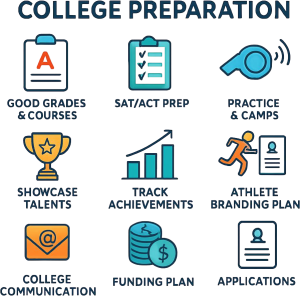 Your high school athletic journey truly begins the moment you earn a spot on the team as a freshman. One of the most important aspects of this experience is recognizing whether you have the competitive ability to take your game to the next level after graduation. As you begin thinking about the recruiting process, there are a few essential steps to guide you:
- You should be competing at the varsity level.
- Consistent playing time is crucial for building meaningful statistics.
- Start collecting game footage and performance content while committing yourself fully to your sport.
High School Athlete Roadmap to College Recruitment
Freshman Year
Goals:
Aim to earn a spot on the varsity team while committing to consistent, focused practice. Develop leadership qualities by supporting teammates and communicating openly with coaches—don’t hesitate to ask questions. Strive to make an impact during games by creating plays and standing out through effort and performance. When mistakes happen, move past them quickly with confidence and keep a positive mindset. Always encourage and uplift your teammates.
To-Do List:
- Record every game—this can be done by a parent, friend, tripod setup, NFHS, Hudl, or by hiring someone to capture full-game footage.
- Track your own stats, even if your coaches already do. Review game film yourself or with a parent to ensure accuracy, and store your data using a stat-tracking app.
- Watch college-level games in your sport to better understand the level of play you’re working toward.
- Work with a trainer to build strength, endurance, and sport-specific skills.
- Join a club team that competes in events and locations where college coaches actively scout talent.
- Create and activate your NCAA player profile.
- Build out profiles on recruiting platforms that allow college coaches to discover athletes.
- Consider working with a recruiting advisor or mentor who understands branding, NIL opportunities, and the recruitment process.
- Keep your social media clean and appropriate—highlight your achievements, family moments, and dedication to your sport.
- Take care of your well-being. Avoid burnout by balancing training with rest, and communicate honestly with your parents and coaches. Pace yourself so you maintain a long-term passion for the game.
Sophomore Year
Goals:
Your freshman year likely came with a long list of expectations, but not everything had to be completed right away. If you didn’t check off every goal, this is the time to refocus and take action. Not making the varsity team as a freshman isn’t a major concern—college coaches are far more interested in your character, skill development, and work ethic.
As a sophomore, your priority should be reflection and growth. Take an honest look at your freshman season: Where did you perform well, and where did you struggle? Identify areas for improvement, whether they involve your skills, mindset, or relationships with coaches. If you faced challenges with coaching or team dynamics, consider how you can improve communication and strengthen those relationships. Also evaluate your club experience—did it meet your expectations, or did it fall short? This is your opportunity to reassess, adjust, and continue progressing.
To-Do List:
- Continue recording games, tracking stats, and building your social media presence.
- Focus on improving weaknesses—both in your athletic performance and in how you contribute as a teammate, including interactions with coaches and parents.
- Evaluate your support system. Determine whether the people around you are helping you grow or holding you back, and make adjustments if needed to better support your development and visibility.
- Research and attend college camps during the offseason to gain exposure and experience.
- Begin reaching out to college coaches via email. This is a great way to practice communication and see who responds. Use templates or seek guidance from an athletic advisor if available.
- Monitor your GPA and ensure you’re meeting NCAA core academic requirements. Staying on track academically is essential.
- Connect with current college athletes—watch their games, reach out with questions, and build relationships. They can offer valuable insight, advice, and even help expand your network.
Stay consistent and keep pushing forward. Motivation can be challenging, but this is your journey. While parents, coaches, and advisors can guide you, the direction you take—and the effort you put in—will ultimately shape your path.
Junior Year
Goals:
You’ve reached the midpoint of your high school career, and this is where things start to accelerate. Challenges are part of the process, but as an athlete, you’re built to handle them. Now is the time to increase your effort and visibility—relationships and exposure matter more than ever.
Take a serious look at your development. By this stage, you should be competing at the varsity level or pushing hard to get there. If you haven’t made varsity yet, use this year to prove your value and show how much you’ve grown. If you’re already established, focus on elevating your performance and preparing for the next level. If there are unfinished goals from earlier years, address them now—this is not the time to fall behind.
To-Do List:
- Prioritize communication. Actively reach out to college coaches so they become familiar with your name, follow your progress, and begin evaluating your game.
- Work with an athletic advisor to build a list of colleges that fit your athletic and academic interests. Start exploring programs, campuses, and coaching staff.
- Identify and attend key scouting events, camps, and open practices where you can gain exposure.
- Stay focused academically. A GPA around 3.2 is a common benchmark across many college programs, and strong grades make you a more attractive recruit.
- Expand your social media presence by consistently posting highlights, achievements, and competition updates.
- Deepen your understanding of your sport—watch games, study film, listen to podcasts, and learn from high-level players and coaches.
- Keep all recruiting profiles current with updated stats, videos, and accomplishments so coaches always see your latest progress.
- Explore branding and NIL opportunities if they align with your goals and personal image.
- Build a comprehensive athletic résumé, including your past seasons, and continue adding to it through junior and senior year. (Download Example Resume)
- Document your journey—journaling can help you stay focused, reflect on progress, and track your goals.
Stay disciplined and intentional. Distractions can increase during this time, so be honest with yourself about your priorities. If playing college sports is your goal, your daily habits should reflect that commitment. Focus on your academics, prepare for standardized tests like the SAT or ACT, and continue finding ways to stand out through your work ethic and performance. Senior year approaches quickly—make this one count.
Senior Year
Goals:
You’ve reached the final stage of your high school career—congratulations. Now the real push begins. Your focus should be on actively promoting yourself to college coaches, setting up calls, scheduling visits, and turning interest into real opportunities. This is not the time to slow down or get comfortable. Coaches have many athletes to choose from, so consistency and persistence are essential. Position yourself as someone they can’t overlook.
To-Do List:
- Create a broad list of colleges across all divisions that interest you. Apply to them and keep a detailed spreadsheet tracking applications, coach communications, and any offers.
- Get a final evaluation of your skills from your athletic advisor to understand where you stand and how to present yourself.
- Secure recommendation letters from coaches, teachers, or mentors who can speak to your abilities and character.
- Research scholarships early and stay on top of deadlines—many require advance preparation.
- Stay in regular contact with coaches through emails and messages. Ask questions, schedule calls, and arrange campus visits to determine the best fit.
- Complete and pay for your NCAA Eligibility Center profile, if you haven’t already finalized it.
- Compare schools by listing pros and cons for each program showing interest in you.
- Attend games at schools you’re seriously considering and let coaches know you’ll be there to demonstrate genuine interest.
- Continue updating your social media and recruiting profiles with highlights, stats, and upcoming game schedules.
- Complete the FAFSA and coordinate with your advisor or school to ensure all financial aid steps are handled properly.
This is the transition point into the next chapter. The past four years moved quickly, but the work you’ve put in now shapes your future opportunities. Stay focused on finishing strong academically, meeting graduation requirements, and securing the best possible fit for your athletic and academic career. Even after committing, your journey doesn’t stop—development, exposure, and opportunities can continue to evolve at the college level and beyond.
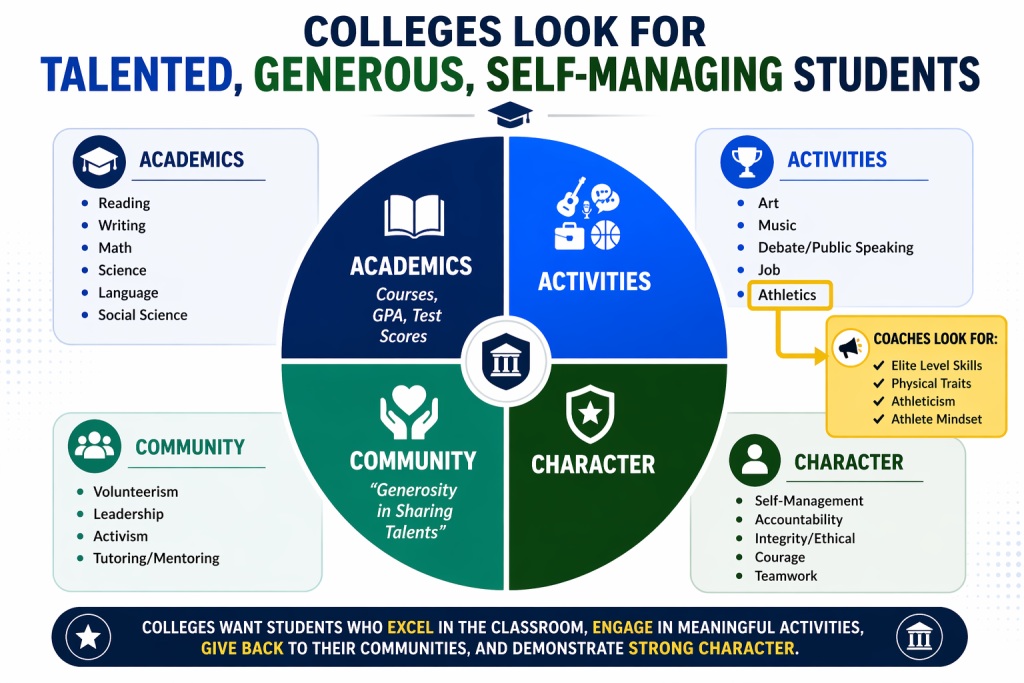
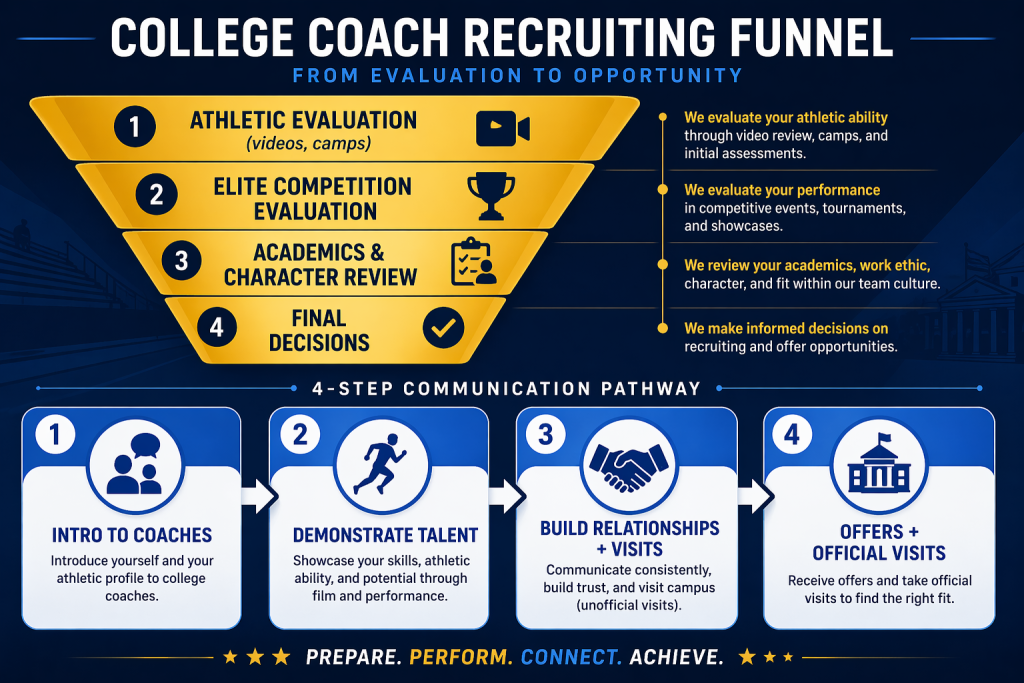
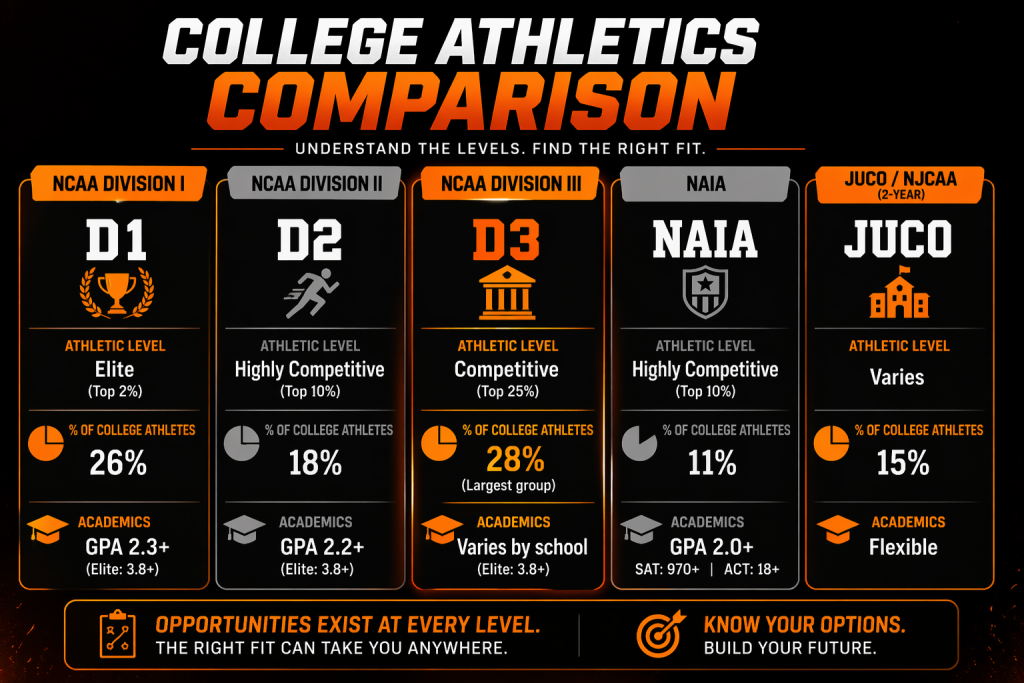
A Student-Athlete’s Guide to College Fit
Sports - Finding Your Athletic Fit
Sports Fit
Did You Know?
Nearly 75% of college athletes compete at the Division II, Division III, NAIA, and junior college levels.
Key Questions to Consider
Level of Competition
Are you targeting schools where your athletic ability matches—or exceeds—the current roster? Finding the right level is critical for both development and playing time.
Time Commitment
Are you prepared to commit 38+ hours per week to your sport, as is typical at the Division I level, while balancing academics?
Priorities
How do you want to divide your time between:
- Athletics
- Academics
- Campus involvement
Multi-Sport Interest
Do you want to continue competing in multiple sports at the college level? If so, which ones?
Playing Time vs. Prestige
Is it more important to:
- Compete immediately and get significant playing time
- Or be part of a higher-level program with more competition for minutes?
Program Fit
Would you rather be:
- A smaller contributor at a top-tier program
- Or a key player at a program where you can make a bigger impact?
Coaching & Culture
What type of coaching style, team environment, and culture help you perform at your best?
Motivation
Why do you play your sport?
- Love of the game
- Team camaraderie
- Competition
- Recognition
- Personal growth
Academic - “Academics Matter—Here’s How to Evaluate
Academic Fit
Did You Know?
Studies show that students who actively engage in campus life and build relationships with professors report the highest levels of satisfaction, regardless of where they attend college.
– Gallup Student Survey, Lumina Foundation
Key Questions to Consider
Academic Profile
Do your GPA and test scores align with the typical admitted student at your target schools? Review published freshman profiles to stay realistic and competitive.
Interests & Career Goals
What subjects do you enjoy most? What are you considering majoring in? Think ahead—how do your academic choices connect to your long-term career goals?
Clarity of Direction
If you’re still undecided, would starting at a junior college help you explore different paths before transferring to a four-year program?
Academic Rigor
If you’re aiming for selective schools or STEM majors, have you taken the right courses (AP, advanced math/science, language)? Are your grades competitive within that applicant pool?
Support Systems
How important are academic support services designed specifically for student-athletes, such as tutoring, advising, and career development?
Environment - Campus Fit Matters
Environment Fit
Did You Know?
Many student-athletes focus on athletics and academics early in the recruiting process—but the campus environment and overall “vibe” often become the deciding factor once they visit in person.
Key Questions to Consider
Location Flexibility
Are you open to attending a college far from home if it increases your chances to compete, receive more scholarship opportunities, or attend your ideal program?
Campus Size & Energy
Do you thrive in large, high-energy environments with many students, events, and opportunities—or do you find them overwhelming?
Learning Environment
Do you prefer smaller classes with more personal interaction, or are you comfortable in larger lecture-style settings?
Campus Setting
What type of environment fits you best:
- Fast-paced urban campus
- Traditional college town
- Quiet, rural setting
Culture & Community
How important are things like:
- Extracurricular activities
- Religious affiliation
- Campus values and culture (diverse, conservative, liberal, etc.)
Belonging & Social Fit
Will you be able to find your people?
Does the school offer a community where you can build friendships, feel comfortable, and enjoy your experience?
Financial - Build a Smart Financial Game Plan”
Financial Fit
Did You Know?
Most college athletes do not receive full scholarships, and many receive only partial aid. In fact, 75% of families say cost is the #1 factor in choosing a college.
– College Savings Foundation
Key Questions to Consider
Budget Reality
What is your annual college budget? Define what your family can realistically afford before exploring options.
True Cost of College
Compare different school types:
- In-state 2-year (living at home)
- In-state 4-year (on campus)
- Out-of-state public
- Private colleges
How much financial aid would you need to make each option affordable—and how realistic is that?
Financial Aid Outlook
What is your Expected Family Contribution (EFC)?
How much financial need do you have, and what percentage of that need do schools typically meet?
Scholarship Expectations
What is the average athletic scholarship at your target schools?
How much total financial aid (athletic + academic + need-based) is typically awarded?
Other Funding Sources
Can you qualify for:
- Academic scholarships
- Need-based grants
- Private or community scholarships
How much of your aid would be grants vs. loans or work-study?
Savings & Contributions
How much has your family saved for college?
Will you contribute through work during summers or school breaks?
Alternative Paths
Would starting at a junior college help reduce costs before transferring to a four-year program?
Loan Consideration
Are you willing to take on student loans? If so, how much is reasonable?
Risk Planning
If you stop playing your sport or get injured, how does that impact your financial plan?
Paying Full Price
Would you attend a school (e.g., Ivy League or walk-on opportunity) without athletic aid if it’s the right overall fit?
Smart Planning Tip
Use college net price calculators and build estimates using conservative assumptions. It’s better to be surprised by lower costs later than higher ones.
Prioritizing Your Decision
Now that you’ve reviewed all four factors, what matters most?
- Sport
- Education
- Environment
- Financial Fit
Most athletes start with sports—but the most successful decisions balance all four.
How to Describe Athletics on a Resume
We recommend starting an athletic résumé to document your journey. It’s an effective way to help college coaches quickly understand your achievements.
Statement for College Goals
This form is designed to help you define and clarify your goals for your college journey. Complete it each school year to track your progress and refine your direction.
Letter of Recommendation -Example
You can use this example as a template when reaching out to coaches and teachers to request a recommendation. It is highly important to get recommendations.
Player Information Form
You will need to gather and complete this information for your athletic advisor, as well as for building and updating your recruiting profiles. Make sure you update this yearly to keep informaiton current.
Initial Email to College Coaches
This example highlights the key information to include in your initial email. Avoid copying it directly—personalize each message to reflect your own experience and genuine interest in the program.
Checklist - Your Recruiting List
Use this checklist to guide your four-year plan toward achieving your college goals. It serves as a valuable tool to help you stay on track throughout the recruiting process.
ready-to-use Recruiting Tracker system
This isn’t just a spreadsheet—it’s a Recruiting Command Center.
It tracks 3 things:
- Outreach (emails to coaches)
- Results (responses, interest, offers)
- Content (what’s driving exposure)
Together, this turns recruiting from guessing → into a system.