The Most Expensive Mistake Families Make
By the time most families consider a prep school, emotions are already involved.
An athlete wants an opportunity.
Parents want to help.
Coaches are making promises.
Recruiting feels urgent.
And suddenly a decision involving tens of thousands of dollars feels like something that must happen immediately.
That’s often when families make their biggest mistakes.
Not because they lack good intentions.
Because they stop asking questions.
As a coach and a parent, I’ve learned that opportunities deserve evaluation.
The best programs welcome tough questions.
The weakest programs avoid them.
Before writing a check, families deserve answers.
Question #1
Why Is My Athlete A Good Fit For Your Program?
If a coach cannot clearly explain why your athlete belongs there, that’s a concern.
The answer should be specific.
Not generic.
Not marketing.
Specific.
Question #2
What Percentage Of Your Athletes Play In College?
Ask for actual numbers.
Not stories.
Not social media posts.
Not highlight reels.
Data.
Question #3
Where Have Your Athletes Been Recruited?
Ask for:
- NCAA Division I
- NCAA Division II
- NCAA Division III
- NAIA
- Junior College
A legitimate program should be able to provide examples.
Question #4
Which College Coaches Do You Regularly Communicate With?
Relationships matter.
Recruiting is built on trust.
Programs should be able to explain their recruiting network.
Question #5
What Does Player Development Look Like?
Development should be planned.
Not assumed.
Ask:
- Strength training?
- Skill development?
- Film study?
- Position-specific work?
- Academic support?
Question #6
What Happens If Recruiting Doesn’t Work Out?
This answer reveals a lot.
Great programs focus on long-term outcomes.
Not just scholarship dreams.
Question #7
What Academic Support Exists?
Athletics open doors.
Academics keep them open.
Never overlook this question.
Question #8
What Is The Daily Schedule?
Structure matters.
Ask what a typical day looks like.
The answer tells you whether the environment promotes growth.
Question #9
How Do You Measure Progress?
If development is a priority, there should be measurable benchmarks.
Question #10
What Is Included In The Cost?
Families deserve transparency.
Ask about:
- Tuition
- Housing
- Meals
- Travel
- Uniforms
- Training
- Additional fees
Know exactly what you’re paying for.
Question #11
What Happens If We Leave Mid-Year?
Read every policy carefully.
Especially financial obligations.
Question #12
How Many Athletes Return?
Retention often reveals more than recruiting brochures.
Question #13
Can We Speak To Former Families?
This may be the most important question of all.
Programs can choose testimonials.
Former families tell real stories.
Question #14
What Are The Biggest Challenges Athletes Face Here?
Honest programs answer honestly.
Be cautious of perfect answers.
Question #15
If This Was Your Child, Would You Make The Same Investment?
Pay attention to the response.
Not just the words.
The confidence behind them.
Green Flags
✅ Transparent recruiting outcomes
✅ Academic accountability
✅ Individual development plans
✅ College relationships
✅ Honest communication
✅ Clear expectations
Red Flags
🚩 Scholarship guarantees
🚩 Vague recruiting claims
🚩 Heavy marketing, little data
🚩 No measurable development plan
🚩 Pressure to commit quickly
🚩 Avoiding difficult questions
The Final Question
At the end of the day, the goal is not to find the most impressive program.
The goal is to find the right opportunity.
Families should not be buying hope.
They should be investing in development.
Because the best opportunities don’t simply create exposure.
They create growth.
And growth is what ultimately creates opportunities.
Series Conclusion
Prep schools can be life-changing.
They can also be expensive mistakes.
The difference usually comes down to one thing:
Whether families make decisions based on information or emotion.
Ask questions.
Demand answers.
Focus on development.
And remember that the right path is not always the most expensive one.
It’s the one that best serves the athlete’s future.
Final Thoughts: Don’t Chase the Dream—Build the Right Path
Prep schools are not bad.
And they are not miracle solutions.
Some athletes thrive.
Some finally get recruited.
Some physically mature and unlock opportunities they otherwise never would have had.
For the right athlete, a prep school can absolutely change the future.
But families also need to understand something difficult:
Not every expensive decision is a smart decision.
Sometimes families spend enormous amounts of money chasing promises that never become reality.
Sometimes emotion replaces research.
Sometimes frustration replaces patience.
And sometimes, in the rush to help an athlete, families place them in environments that hurt more than they help.
So if there is one thing I would tell parents, it is this:
Slow down.
Ask hard questions.
Research everything.
Separate emotion from evidence.
Talk to former families.
Talk to coaches.
Talk to people who are not trying to sell you something.
And most importantly:
Remember what sports are supposed to teach.
Because eventually, every athlete walks off the court for the final time.
When that moment comes, the goal should not only be scholarships, rankings, or recruiting attention.
The goal should be this:
That your child walks away stronger.
More confident.
More disciplined.
More resilient.
And proud of the work they put in.
I still think about my daughter during those final moments.
Hungry.
Frustrated.
Waiting for a chance.
Then finally getting it.
A steal.
A bucket.
Two free throws.
A spark after weeks of disappointment.
Maybe the lesson was never about playing time at all.
Maybe it was about being ready when life finally opens the door.
Because sometimes, all you get is two minutes left on the clock.
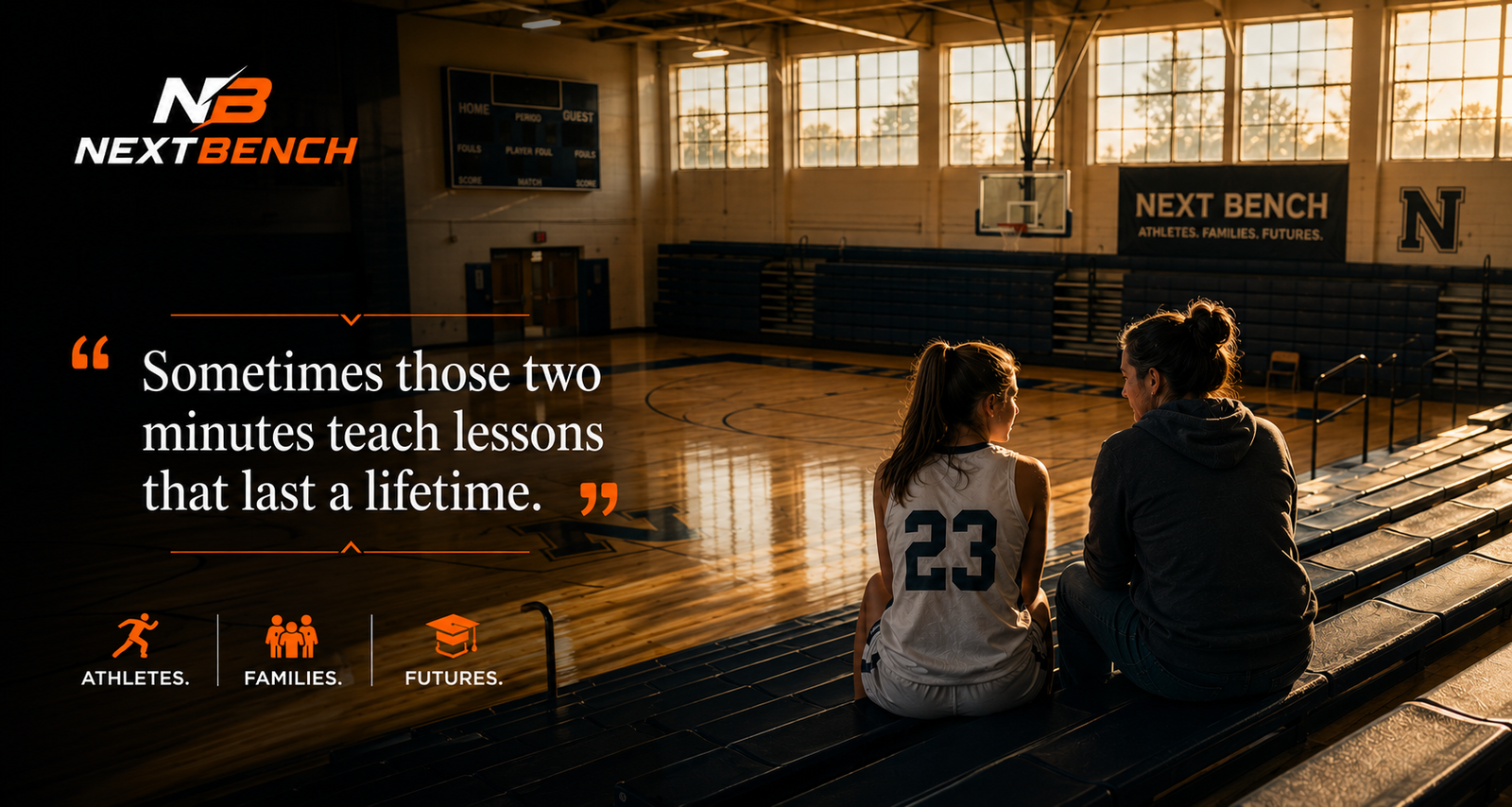
And sometimes those two minutes teach lessons that last a lifetime.
The right path isn’t always the most expensive one.
It isn’t always the most popular one.
And it isn’t always the one that looks best on social media.
The right path is the one that helps an athlete grow into the person they’re capable of becoming.
That’s a return on investment no recruiting service, prep school, or scholarship offer can ever fully measure.